In 2026, choosing a CRM is no longer just about storing contacts, deals, and tickets. Companies need a platform that reduces manual work, connects teams, and helps users act faster. This is where HubSpot stands out.
Compared with many CRM and marketing automation tools that require heavy customization or disconnected add-ons, HubSpot brings marketing, sales, service, content, operations, automation, and AI into one customer platform. Its recent Spring 2026 Spotlight reinforced this direction, with updates focused on awareness, revenue growth, customer support, and AI-powered productivity.
For companies in Portugal, this is especially relevant. As a HubSpot partner in Portugal, Sollogica helps businesses implement, integrate, and optimize HubSpot so teams can spend less time on repetitive work and more time on growth.
1. Breeze: HubSpot’s AI layer for everyday productivity
One of HubSpot’s biggest advantages is Breeze, its AI layer across the platform. Breeze includes AI assistants and agents that help teams create content, summarize information, answer questions, and automate tasks inside HubSpot.
The key benefit is context. Instead of using a separate AI tool with no connection to your CRM, Breeze works with HubSpot data, customer records, workflows, and business context. This helps users move faster without switching between tools.
For marketing, sales, and service teams, that means fewer repetitive tasks, less manual research, and faster execution.
2. HubSpot AEO: helping brands stay visible in AI search
Search behavior is changing. Buyers are increasingly using AI tools such as ChatGPT, Gemini, and Perplexity to research solutions. HubSpot AEO, or Answer Engine Optimization, helps companies understand how they appear in AI-generated answers and provides recommendations to improve visibility.
This gives HubSpot an important advantage for marketing teams. Traditional SEO remains important, but HubSpot now helps businesses prepare for a world where customers ask AI engines for product, service, and vendor recommendations.
For companies that already use HubSpot for content, CRM, and campaigns, AEO adds another layer of visibility without requiring a completely separate marketing stack.
3. Breeze Assistant for Loop Marketing
HubSpot’s Breeze Assistant also supports Loop Marketing, HubSpot’s AI-era marketing framework. It helps marketers define ideal customer profiles, build brand guides, and create campaign briefs using real customer context.
This reduces the time spent on campaign planning and brief creation. Instead of starting from a blank page, teams can use HubSpot data to build more relevant campaigns faster.
For companies managing multiple audiences, languages, or markets, this can make marketing operations more consistent and easier to scale.

4. Prospecting Agent: less manual sales research
Sales teams often spend too much time researching companies, looking for buying signals, identifying contacts, and preparing outreach. HubSpot’s Prospecting Agent helps automate that work by identifying opportunities, prioritizing accounts, finding contacts, and drafting personalized outreach for sales reps to review.
This is where HubSpot becomes more than a database. It helps sales teams decide who to contact, when to act, and how to personalize the approach.
The result is a lower administrative workload and more time for actual selling.
5. Smart Deal Progression: cleaner pipelines with less effort
CRM data is only useful when it is updated. But in many sales teams, deal stages, notes, next steps, and close dates are often incomplete because reps are busy selling.
HubSpot’s Smart Deal Progression helps solve this by analyzing sales interactions and deal history to suggest CRM updates, draft follow-up emails, and surface action items.
For users, this reduces manual CRM maintenance. For managers, it improves pipeline visibility. For leadership, it supports more accurate forecasting.
This is one of the strongest examples of HubSpot’s automation advantage: the platform does not just record activity; it helps turn activity into action.
6. Customer Agent: automated support with customer context
HubSpot’s Customer Agent helps service teams automate routine customer support. It can use help documentation, CRM data, and conversation history to answer customer questions and hand off to human agents when needed.
This reduces the workload on support teams while helping customers get faster answers. Instead of assigning every simple question to a human agent, HubSpot can handle repetitive requests and keep service teams focused on more complex cases.
For growing companies, this is a practical way to scale customer support without immediately increasing headcount.

7. Campaign automation inside HubSpot workflows
HubSpot has also improved campaign automation. Campaign properties and campaign events can now be used in workflows, helping teams automate actions based on campaign-level data. For example, marketing teams can trigger alerts, follow-up actions, or internal notifications when campaign activity reaches a specific condition.
This makes campaign management more operationally efficient. Instead of manually checking performance, notifying sales, or coordinating follow-up, teams can build automated processes inside HubSpot.
The advantage is not only time savings. It also improves consistency between marketing and sales, because campaign activity can automatically trigger the right next step.
8. Smart CRM index: faster access to the data that matters
HubSpot’s redesigned Smart CRM index gives users a more efficient way to manage contacts, companies, deals, tickets, and custom objects. It includes collapsible filters, inline report views, and Breeze AI column insights, helping teams work with CRM data without constantly moving between screens.
This matters because CRM adoption depends on usability. If users can find records, analyze data, and update properties faster, the CRM becomes part of daily work instead of another administrative burden.
For teams comparing HubSpot with competing platforms, this ease of use is a major differentiator.

9. AI connectors / MCP: connecting HubSpot to the wider tech stack
HubSpot is also extending AI beyond its own interface. Through MCP and AI connectors, HubSpot can connect CRM context with other tools and AI clients, helping teams access and use HubSpot data in more flexible ways. HubSpot has highlighted MCP-related updates as part of its broader AI and platform evolution.
This is important for companies with complex systems. HubSpot can act as the central customer platform while still connecting with other business tools.
The result is a more integrated technology stack and fewer disconnected processes.
What this means for businesses
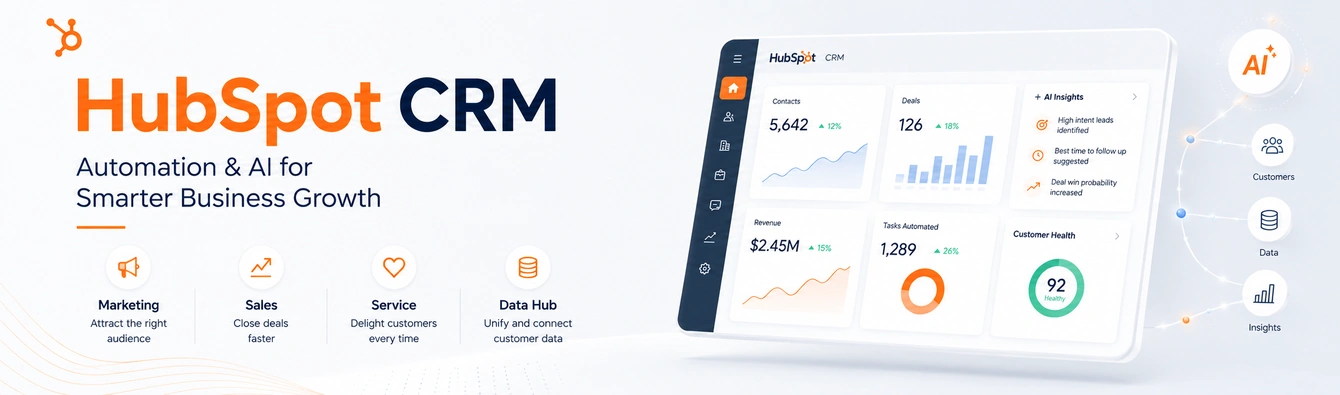
HubSpot’s biggest advantage is not one isolated feature. It is the combination of CRM, automation, AI, data, reporting, marketing, sales, and service in one platform.
For businesses, this means:
- Less manual data entry.
- Faster campaign planning.
- More efficient lead follow-up.
- Cleaner sales pipelines.
- Better support automation.
- Stronger alignment between marketing, sales, and service.
- More time for teams to focus on strategic work.
In a competitive CRM market, HubSpot stands out because it helps users reduce workload while keeping customer data, automation, and AI connected.
Why work with Sollogica as your HubSpot partner in Portugal
HubSpot’s newest AI and automation features are powerful, but they need to be configured around your business model. A generic setup will not deliver the same results as a structured implementation that reflects your sales process, customer journey, data model, service operations, and reporting needs.
That is where Sollogica can support companies. As a HubSpot partner, Sollogica helps organizations implement HubSpot, migrate CRM data, integrate systems through custom APIs, configure programmable automation, align sales and marketing, implement help desk processes, and build knowledge bases that can support both human teams and AI agents.
For Portuguese companies, working with a local HubSpot partner also makes adoption easier. Teams can receive support in Portuguese and English, align the platform with local business realities, and build automation’s that match the way their organization actually operates.

Conclusion: HubSpot reduces workload by turning CRM data into action
The future of CRM is not just about managing customer information. It is about reducing the manual work required to use that information.
HubSpot is moving strongly in that direction. With Breeze, AI agents, Smart Deal Progression, Customer Agent, campaign automation, HubSpot AEO, and the Smart CRM index, the platform helps teams automate repetitive tasks, improve decisions, and act faster.
For companies in Portugal, this creates a clear opportunity: use HubSpot not only as a CRM, but as an automation-driven growth platform. With Sollogica as a HubSpot partner in Portugal, businesses can configure HubSpot around their real processes, reduce operational workload, and give their teams more time to focus on customers, revenue, and growth.
If you wish to find out more about these topics, reach us through the available channels, or schedule a meeting at your availability.